

A website that publishes consistently will eventually accumulate overlap. Several articles may answer the same question, older pages may contain outdated advice and valuable backlinks may point to content nobody maintains. The wrong response is a mass deletion based on page views alone.
Content pruning is a controlled editorial and technical process. The aim is to make the remaining library more useful, coherent and maintainable while preserving pages and signals that still serve customers.
Do not begin with a word-count rule
A short page is not automatically low quality, and a long page is not automatically helpful. A concise policy answer may fully satisfy its audience. A 2,000-word article can still be repetitive or inaccurate.
Google’s people-first content guidance focuses on original information, completeness, expertise and whether readers leave feeling they achieved their goal. Use those questions alongside performance and business data.
Build a complete URL inventory
Export indexable pages from the CMS, sitemap, analytics, Search Console and a crawl. Include pages that receive no traffic because zero analytics visits do not prove that a URL is unimportant or unindexed.
For each URL, record:
- title, type, topic, audience and owner;
- publication and meaningful update dates;
- canonical URL, index status and HTTP response;
- organic clicks, impressions and query themes;
- other traffic, engagement and conversions;
- internal and external links;
- accuracy, uniqueness and brand risk;
- the strongest competing page on the same site.
Add human review. A spreadsheet cannot judge whether legal guidance is stale, a product has been discontinued or a case study still has permission to name a customer.
Group pages by intent, not only keyword
Two pages can use similar words but serve different decisions. A beginner’s guide to Google Ads and an implementation checklist for conversion tracking do not necessarily compete. Conversely, pages with different titles may answer the same question and divide internal links and maintenance effort.
For every topic cluster, identify the primary page and the supporting subtopics. Map which page should rank for which intent. This becomes the target architecture for consolidation and future internal linking.
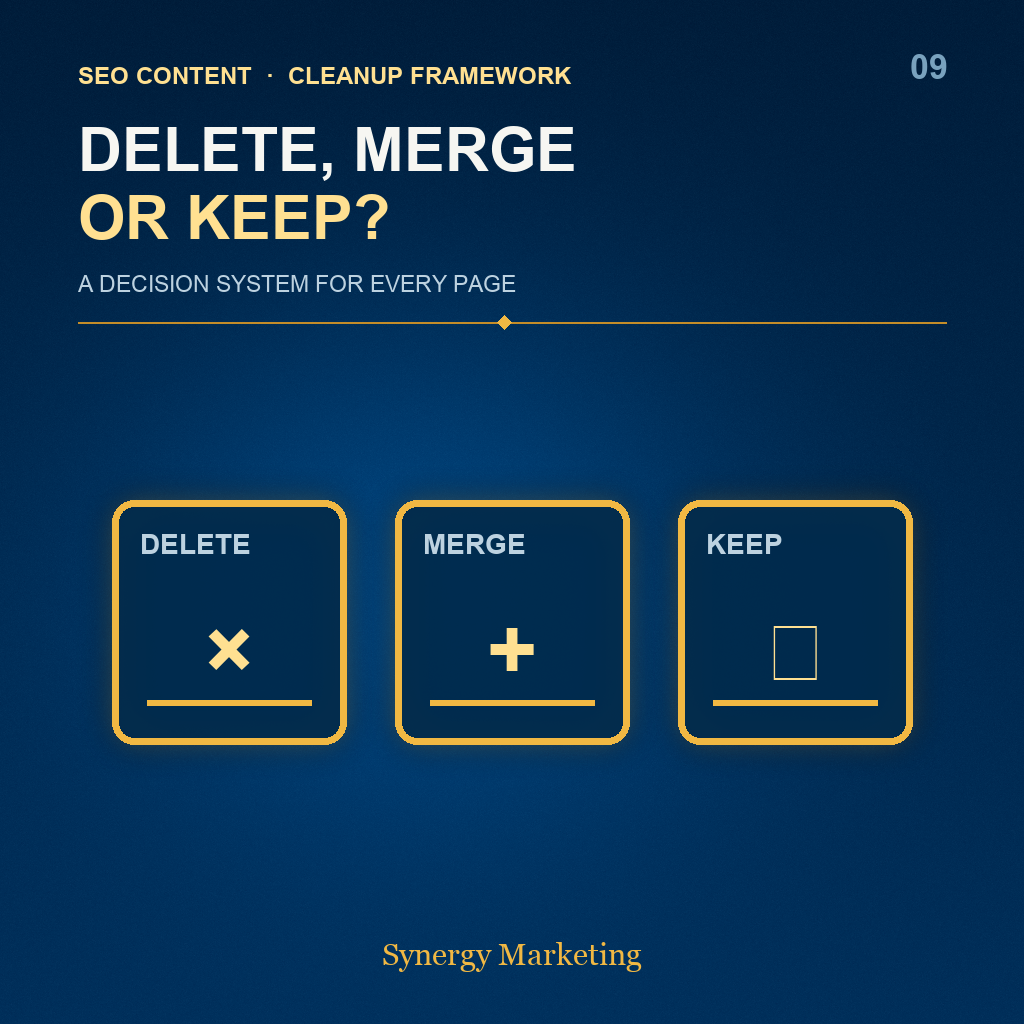
Use a five-way decision framework
Keep
Retain a page when it is accurate, distinct, useful and aligned with the business. Improve internal links or metadata if needed, but do not rewrite it merely to change the date.
Update
Refresh a page when the intent remains valuable but evidence, examples, screenshots or recommendations have changed. Preserve useful material, disclose meaningful updates and have a qualified reviewer check specialist claims.
Merge
Combine pages when several thin or overlapping articles would serve readers better as one authoritative resource. Select the strongest destination based on relevance, links, performance and URL suitability. Move unique value into it before redirecting the retired URLs.
Noindex or restrict
Some pages are useful to customers but not appropriate search destinations: internal search results, duplicate filters, account pages or temporary campaign variants. Apply the correct technical control after confirming the business need and platform behaviour.
Remove and redirect—or return the right status
If a page no longer has value, decide whether there is a genuinely equivalent replacement. Use a permanent redirect when the destination satisfies the old intent. Do not send every removed article to the homepage; that creates a poor user experience and weak relevance. If no replacement exists, an appropriate not-found or gone response may be more honest.
Canonical tags are not a substitute for architecture
Google explains that canonical methods indicate a preferred URL among duplicate or very similar pages and help consolidate signals. They are useful for legitimate URL variants. They do not resolve two different articles that compete because the editorial strategy is unclear.
Use redirects for retired pages, canonical tags for necessary duplicates, and internal links that consistently point to the preferred destination. Keep sitemaps limited to canonical URLs you want indexed.
Protect value before changing URLs
Review backlinks, conversions, referral traffic, assisted journeys and internal dependencies. Export current metadata and content. Capture a baseline of indexed pages, clicks, impressions and priority rankings. Prepare a redirect map and test it in a staging environment where possible.
Roll changes out in manageable groups. A smaller batch makes errors easier to diagnose and reverse. Update internal links directly instead of relying on redirect chains.
Monitor the result as a migration
After release, crawl the changed URLs, test redirects, inspect canonical signals, resubmit the sitemap if appropriate and monitor Search Console. Watch the destination pages for query coverage and conversions, not only ranking positions.
Expect reprocessing time. Do not reverse a sound plan after a few days because one keyword moves. Investigate sharp drops, redirect errors or unexpected deindexing promptly, but evaluate the content architecture over a meaningful window.
Prevent the archive from becoming cluttered again
Assign every topic a primary intent and owner. Require briefs to identify existing competing pages. Set review dates for time-sensitive content and retire campaign pages through a documented workflow. A content calendar should include updates and consolidation, not only new posts.
The Synergy blog covers several marketing disciplines; maintaining clear clusters is as important as publishing frequency. Our SEO service combines content review with indexing, architecture and conversion evidence.
Do you know which pages are helping—and which are competing?
Request a free content and SEO audit before deleting or redirecting live URLs.

 English
  香港中文
香港中文